AI Workflow Review Framework
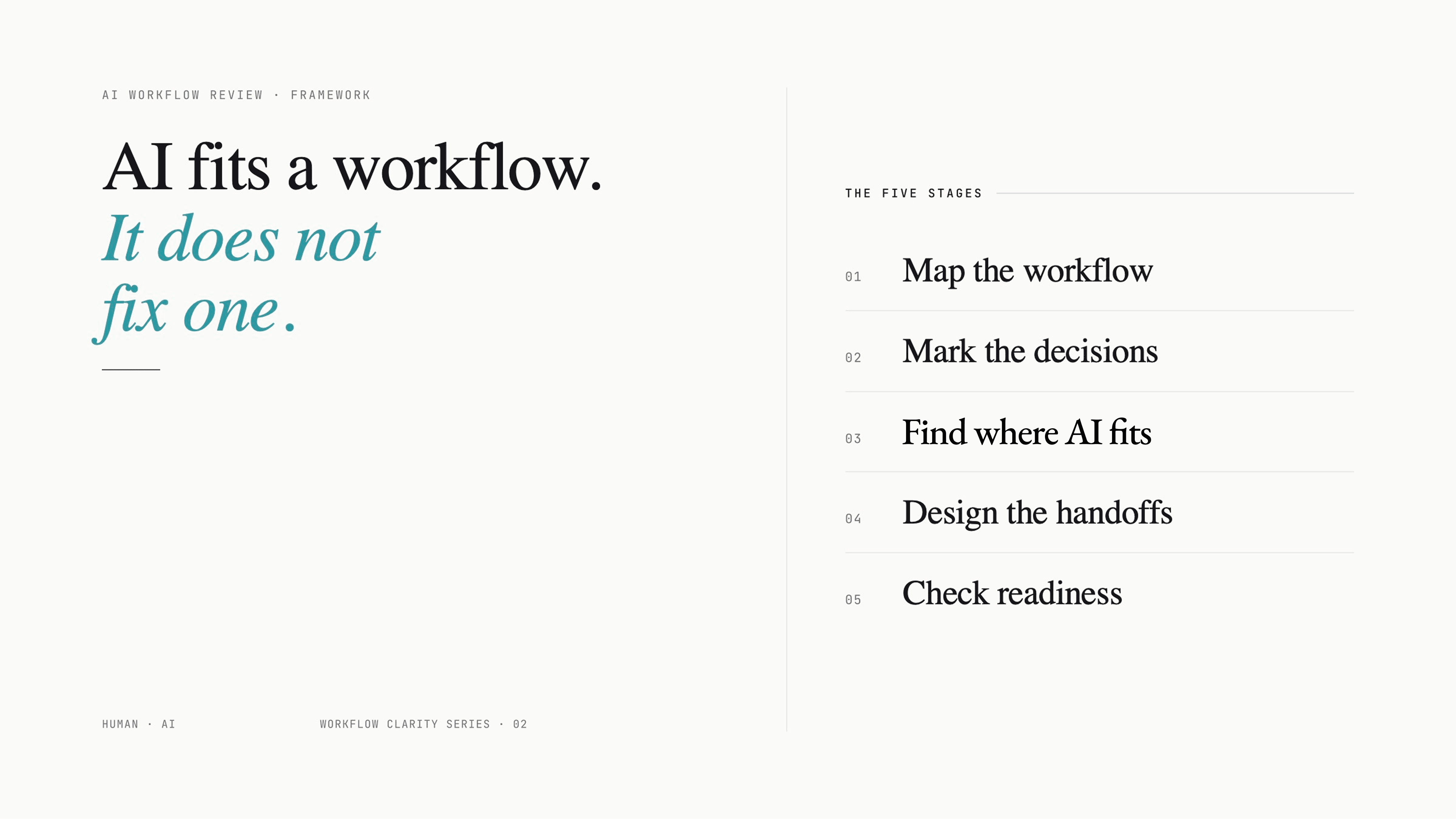
Most teams ask us which AI tool to buy. Almost no one asks whether the workflow is ready for one. That is the first question worth answering.
Who this is for
Small service businesses where AI is a live question: considering it, already experimenting with it, or questioning whether an existing tool is worth continuing. The team has enough authority to refine how the work happens. The lens shifts with the situation; the method does not.
It is not for:
Ad-hoc AI use with no team or recurring process.
Compliance review. That work belongs with legal counsel.
Why workflows come first
Most AI adoption issues start as workflow issues.
A workflow is ready for AI when the steps are clear, the decisions are visible, the context is available, human judgment is intentional, and handoffs have an owner.
When these conditions are not met, AI inherits the problems instead of solving them. In one engagement, what looked like an AI problem was actually a missing handoff between two teams. We refined the handoff. After that, the AI work was easy.
The issue was not model quality. It was that no one owned what happened after the AI surfaced the case.
The bar shifts with the stakes
Apply the framework with a risk tier in mind.
Low stakes
Internal, reversible, and reviewed before publishing.
Examples: internal drafts, B2B marketing copy, summarization.
Medium stakes
Customer-facing, partly reversible, with some regulatory exposure.
Examples: scheduling, routing, client communication.
High stakes
Health, legal, financial, regulated, or hard-to-reverse decisions.
Examples: clinical intake, contract drafting, financial advice.
The higher the stakes, the stricter each stage needs to be before AI is added.
Five stages, three signals
Each stage produces one of three signals.
Ready
AI can support this part of the workflow as it stands.
Refine First
The workflow needs targeted changes here before AI is added.
Not Yet
AI should not enter at this point, for operational, regulatory, or organizational reasons.
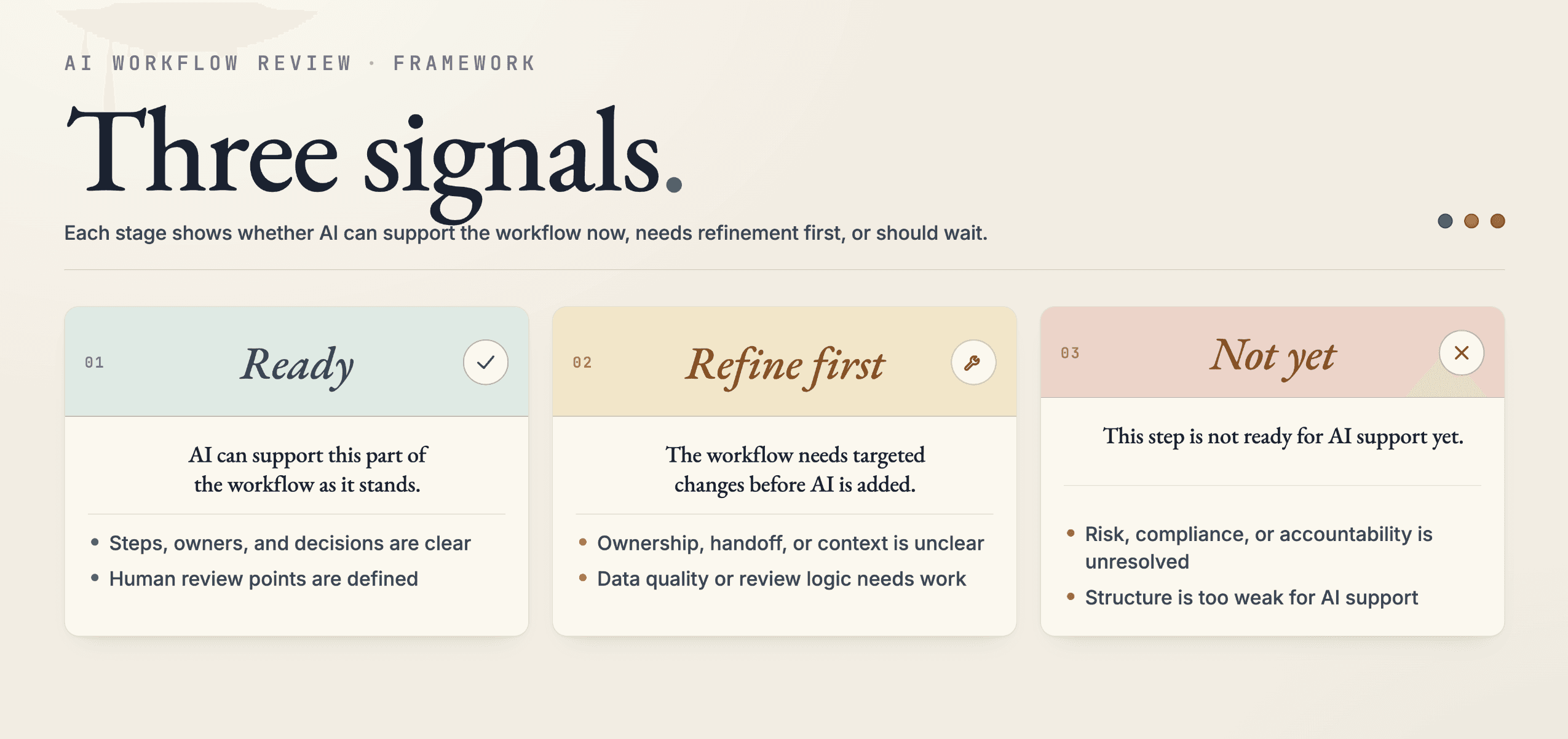
Each stage ends with one question. The answer determines the signal.
1. Map the workflow
Map how the work actually happens, not how it is described in process documents. Repeated steps, unclear ownership, and manual cleanup surface here.
Is the current state clear enough that AI would not inherit hidden problems?
2. Mark the decisions
Separate tasks from decisions. A task has a checkable answer, like extracting data or summarizing a document. A decision depends on judgment, like approving a refund or escalating a case.
Tasks tolerate automation: errors are noticeable and reversible. Decisions usually do not: a wrong call can stay invisible until the consequences show up.
Are the decisions identified, and is it clear which ones must stay with people?
3. Find where AI fits
Once the decisions are marked, look at what is left. Find where AI can summarize, draft, classify, or route. Flag where it would add risk or extra review work. If the step involves regulated data, decisions, or disclosures, the signal stays Not Yet until compliance review clears it.
Does AI add value here, or does it add overhead?
4. Design the handoffs
When AI stops, design who picks up, and what context they need to act. Handoffs are where most AI workflows break.
When AI stops, does someone pick up with the context they need?
5. Check readiness
Check data quality, ownership, content gaps, integrations, and monitoring. A workflow can be conceptually ready and operationally not.
Can this be piloted without creating problems elsewhere?
After the review
The signals add up to one of three calls.
All Ready: scope a pilot.
Some Refine First: make the targeted changes, then re-read the signals.
Any Not Yet: hold. AI does not enter at that point until the underlying reason clears.
Most workflows land in a mix. The work is reading the mix honestly and deciding what to refine before any tool is chosen.
Workflow readiness is the work. AI is what follows.
This is the framework behind the AI Fit Review. The Review applies it to your business in one to two weeks.